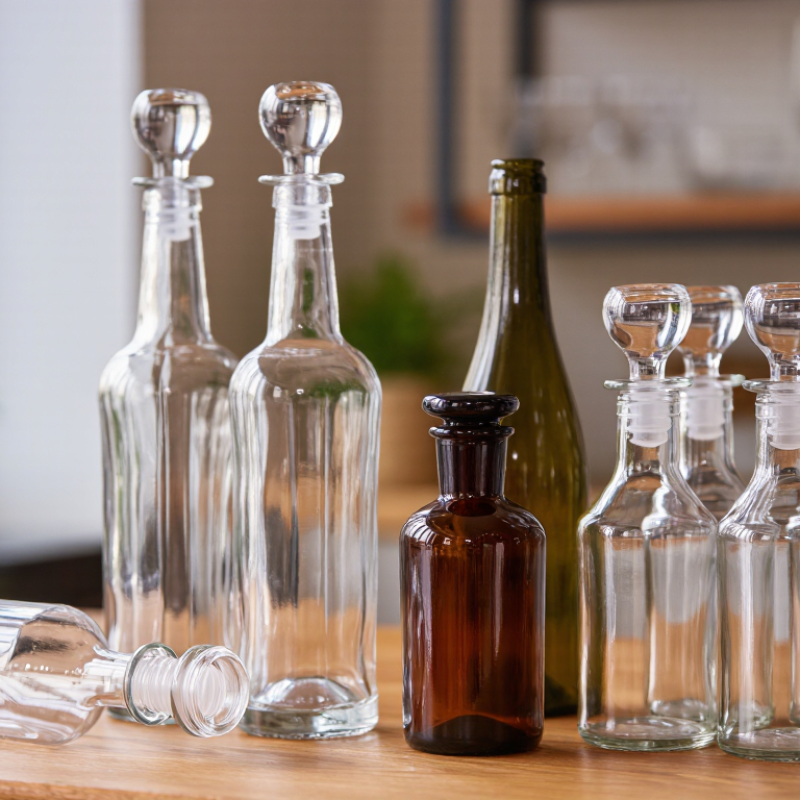
| 1. Match capacity to use |
Small round bottle |
100–250 ml |
Compact footprint; usually stable when the base is broad relative to its height. |
Small opening, commonly about 18–25 mm. |
Very suitable
Light stopper is easier to remove and replace. |
High
Easy to hold with one hand. |
Moderate
Better for small quantities and controlled pours. |
Flavored oils, extracts, samples, and table condiments. |
| 2. Compare overall proportions |
Tall cylindrical bottle |
500–750 ml |
Uses vertical space efficiently; a heavy or widened base improves resistance to tipping. |
Medium opening, commonly about 20–30 mm. |
Very suitable
Long necks commonly pair well with fitted glass stoppers. |
Moderate
Comfort depends on neck diameter and surface texture. |
High
Long neck can help produce a controlled stream. |
Water, infused beverages, syrups, and kitchen storage. |
| 3. Check grip before purchase |
Short, wide bottle |
250–500 ml |
Low center of gravity and broad base provide strong countertop stability. |
Medium-to-wide opening, commonly about 30–45 mm. |
Suitable
Requires a stopper with a matching sealing section. |
Very high
Short height and wide body are comfortable for frequent handling. |
Moderate
Wide openings may release liquid faster. |
Dressings, sauces, preserves, and serving bottles. |
| 4. Inspect the neck and lip |
Square or rectangular bottle |
250–750 ml |
Flat sides can improve shelf organization; corners may require careful handling. |
Usually narrow to medium, about 20–30 mm, with a defined lip. |
Suitable
A clearly formed lip helps position the stopper consistently. |
Moderate
Flat panels improve alignment but corners may feel less ergonomic. |
High
Often provides a predictable pour when the neck is narrow. |
Pantry storage, bar service, and space-efficient displays. |
| 5. Evaluate stopper removal |
Long-neck wine-style bottle |
500–750 ml |
Stable when the base is sufficiently heavy; taller design needs more storage clearance. |
Narrow opening, commonly about 18–22 mm. |
Very suitable
Conical glass stoppers can seat firmly in a compatible neck. |
Lower
Requires a larger hand span and careful stopper removal. |
High
Narrow neck supports a slower, more precise stream. |
Table beverages, infused oils, and decorative serving. |
| 6. Prioritize cleaning access |
Wide-mouth apothecary bottle |
250–1,000 ml |
Often broad and stable; heavier walls can increase total weight. |
Wide opening, commonly about 35–55 mm. |
Suitable
Needs a precisely sized stopper or sealing collar to prevent leakage. |
High
Easy to grip and easier to clean by hand. |
Moderate
Liquid may flow quickly through the larger mouth. |
Dry goods, thick liquids, homemade infusions, and frequent refilling. |
| 7. Confirm seal and storage needs |
Heavy-base decanter bottle |
500–1,500 ml |
Weighted base offers excellent stability but substantially increases lifting weight. |
Medium opening, commonly about 25–40 mm. |
Very suitable
Designed for a visible, closely fitted glass stopper. |
Moderate
Comfortable for serving but less convenient for repeated transport. |
High
Balanced neck and weight support controlled serving. |
Spirits, table presentation, long-term countertop storage, and gifting. |